
Study in UK Without IELTS: MOI, Duolingo, PTE Options Explained (2026)
Let’s be honest.
For many students in Tamil Nadu, the word “IELTS” itself feels like pressure. Some people fear speaking. Some worry about writing. Some just do not want to spend months preparing.
So the big question comes up every day:
“Can I study in the UK without IELTS in 2026?”
Yes, in many cases, you can get admission without IELTS. But your UK Student visa has its own rules. That is where many students get confused and lose time.
In this blog, I will explain everything in very simple English, like you are talking to a senior who already did the process.
We will cover:
- MOI (Medium of Instruction)
- Duolingo English Test (DET)
- PTE (including PTE Academic UKVI for visa)
And I will clearly tell you what works for:
- UK university admission, and
- UK Student visa English requirement.
First, one important truth: Admission and Visa are not the same
Think of it like a two-step gate.
Gate 1: University admission
The university decides which English proof it accepts. Some accept IELTS, some accept PTE, some accept Duolingo, and some accept MOI.
Gate 2: UK Student visa
For the visa, you must prove English in one of the ways UKVI allows. For degree level courses, the Higher Education Provider (HEP) can sometimes assess your English itself (so you may not need a SELT). But for many cases, you may still need a UKVI-approved SELT test.
If you remember only one line from this blog, remember this:
A test accepted by a university is not always accepted for visa.

What does the UK Student visa ask for in 2026?
UKVI says you must prove you can read, write, speak, and understand English:
- Degree level or above: at least CEFR B2
- Below degree level: CEFR B1
You can prove English in a few ways, including:
- a degree taught in English (UK or outside UK)
- or an approved English test (SELT)
Also important:
- If your degree was taught in English outside the UK, UKVI says you may need an Ecctis assessment code to confirm it was taught in English and matches a UK degree level.
- If you are studying degree level or above, a Higher Education Provider (HEP) can assess English themselves and may ask for a different test.
Now let’s break your options one by one.
Option 1: MOI (Medium of Instruction)
What is MOI?
MOI means your previous education was taught in English medium. Many colleges in India can give an MOI letter saying: “This student studied in English medium.”
This is popular because students think: “Why should I take IELTS if I already studied in English?”
Fair question. But here is the clear answer.
Does MOI work for UK university admission?
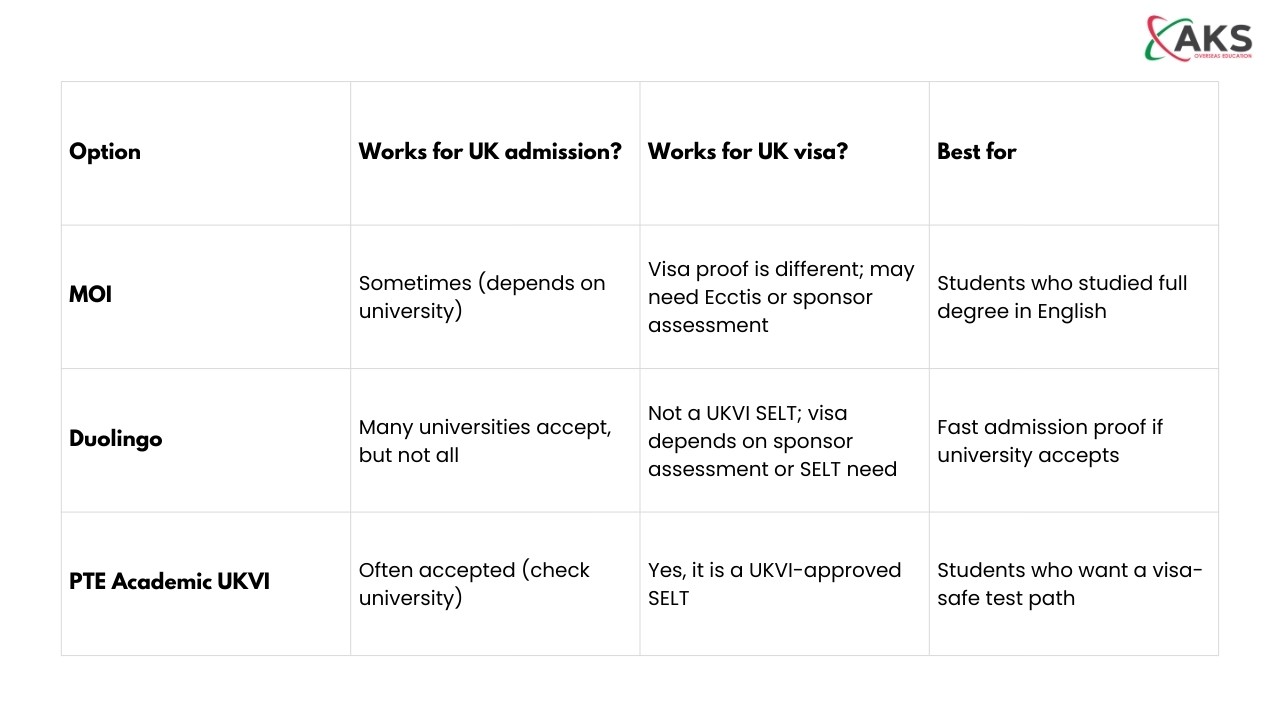
Sometimes yes.
Many UK universities may accept MOI for admission, mainly when:
- your full degree was taught in English
- your college issues a proper MOI letter
- and the university policy allows it
But not all universities accept MOI. Some will still ask for IELTS or another test.
So MOI is not a “fixed rule”. It is a “depends on university” option.
What should your MOI letter include?
If you are using MOI for admission, try to get an MOI letter with:
- your full name and register number
- course name and study years
- clear line: “Medium of instruction was English”
- college seal and signature
- date on letterhead
Small tip from our experience at AKS Overseas Education: If your letter looks too short or unclear, universities may reject it and ask for a test.
Does MOI work for UK Student visa?
Here is where students must be careful.
For the visa, UKVI clearly says you can prove English using:
- a degree taught in English from outside the UK, but you may need an Ecctis assessment code to confirm it.
So MOI letter alone is not a “magic visa document”. The visa decision depends on your route and how your sponsor assesses English.
Best use of MOI in 2026
Use MOI mainly for:
- admission, if your chosen university accepts it Then check if your visa route needs a SELT or not, based on your sponsor and course level.

Option 2: Duolingo English Test (DET)
What is Duolingo English Test?
Duolingo English Test is an online English test you can take from home. It is popular because:
- it is online
- it is shorter
- results come fast
Duolingo scores are on a 10 to 160 scale. The test process is about 1 hour. Duolingo says results usually come within 2 days.
Do UK universities accept Duolingo in 2026?
Many do, yes. Duolingo has an official page where you can check accepting institutions.
But here is a real-world truth: Some universities accept Duolingo, some do not.
Example: University of East London (UEL) clearly states Duolingo is not currently accepted on its English requirements page.
So do not trust random lists only. Always check the exact university page for your course.
Is Duolingo accepted for UK Student visa?
Duolingo is not listed as a UKVI-approved SELT on the UK government SELT guidance. UKVI accepts SELT tests only from approved providers and specific test names.
But remember the earlier point: If you are studying degree level or above, a Higher Education Provider can sometimes assess English themselves (they may accept a different test).
So, Duolingo can be useful for admission, and in some cases your sponsor’s assessment may cover the visa requirement. But you must confirm with your university and your visa file path.
Who should choose Duolingo?
Duolingo can be a smart choice if:
- your university accepts it for admission
- you need quick results
- you can take the test at home
But do not choose Duolingo blindly if your case will need a SELT for visa. UKVI rules for SELT are strict.

Option 3: PTE (Best option when you want a clear visa-safe path)
What is PTE?
PTE is another English test accepted by many universities.
But for UK visa, the key word is:
PTE Academic UKVI
Pearson clearly states PTE Academic UKVI is a SELT version and gives a Unique Reference Number (URN) for the visa application.
So if you want a simple “less confusion” option, PTE Academic UKVI is often chosen because:
- it is on the UKVI SELT list (as PTE Academic UKVI)
- it works for visa where a SELT is required
PTE Academic vs PTE Academic UKVI (simple difference)
- PTE Academic: may be used for admission (depends on university)
- PTE Academic UKVI: made for visa use as a SELT, includes the UKVI reference
If your case needs a SELT for the visa, do not book the wrong version.
Who should choose PTE Academic UKVI?
Choose PTE Academic UKVI if:
- you want a safer visa-friendly test option
- your university accepts PTE
- you want to avoid confusion between admission proof and visa proof

Quick comparison table (easy to understand)
So, how do you decide? Use this simple “Tamil Nadu student” checklist
Answer these 5 questions:
1) Are you applying for a degree level course (Bachelor or Master)?
If yes, your sponsor may assess your English without a SELT, but it must still be B2 level.
2) Does your university accept MOI?
If yes, MOI can help for admission. If no, move to Duolingo or PTE.
3) Does your university accept Duolingo?
If yes, Duolingo can be a quick admission tool. If no, skip it.
4) Do you want the safest path for visa English proof?
If yes, choose a UKVI-approved SELT like PTE Academic UKVI (or IELTS for UKVI).
5) Do you have a degree taught in English outside the UK?
If yes, UKVI says you may need an Ecctis assessment code to confirm it.
Common mistakes students make (please avoid)
Mistake 1: “My friend got UK without IELTS, so I also can”
Your friend’s university, sponsor type, course level, and documents may be different.
Mistake 2: Using Duolingo and thinking visa is done
Duolingo is not on the UKVI SELT list. SELT rules are strict.
Mistake 3: Booking the wrong PTE
If you need visa SELT, you must book PTE Academic UKVI, not normal PTE Academic.
Mistake 4: MOI letter that looks weak
If the university doubts it, they will ask you for a test. Keep the MOI letter clear and official.
Real examples (simple and realistic)
Example A: Master’s student from Chennai with English-medium degree
- University accepts MOI for admission
- Course is degree level
- University (HEP) assesses English and issues CAS Result: Student may not need a SELT, but must follow sponsor instructions and UKVI rules.
Example B: Student chooses Duolingo for fast admission
- University accepts Duolingo for admission
- Student gets offer quickly
- For visa, student is told to provide a SELT Result: Student takes PTE Academic UKVI or IELTS for UKVI and proceeds.
Example C: Student has a non-UK degree taught in English and wants to use it for visa proof
- UKVI says Ecctis can confirm degree level and taught in English Result: Student follows that route if applicable.
How AKS Overseas Education helps Tamil Nadu students (without confusion)
At AKS Overseas Education, we do not give “one size fits all” answers. We check:
- your course level
- your university’s English policy
- your best option among MOI, Duolingo, PTE
- and what will be safe for your UK Student visa process
We also help you avoid last-minute shocks like: “University accepted Duolingo, but visa needs SELT.”
Final takeaway (save this)
If you want to study in UK without IELTS in 2026, it is possible, but only when your route fits.
- MOI can work for admission (depends on university).
- Duolingo can work for admission (many accept, some do not).
- For visa, if you need a SELT, use PTE Academic UKVI or another UKVI-approved SELT.
- For degree level, your HEP sponsor can assess English, and may accept a different test.
Small disclaimer (important)
University rules and UKVI rules can change, and each student case is different. This blog is general guidance. Always follow the latest UKVI guidance and your university’s official English requirement page.