
UK Course With Placement or Without Placement: Which Is Better?
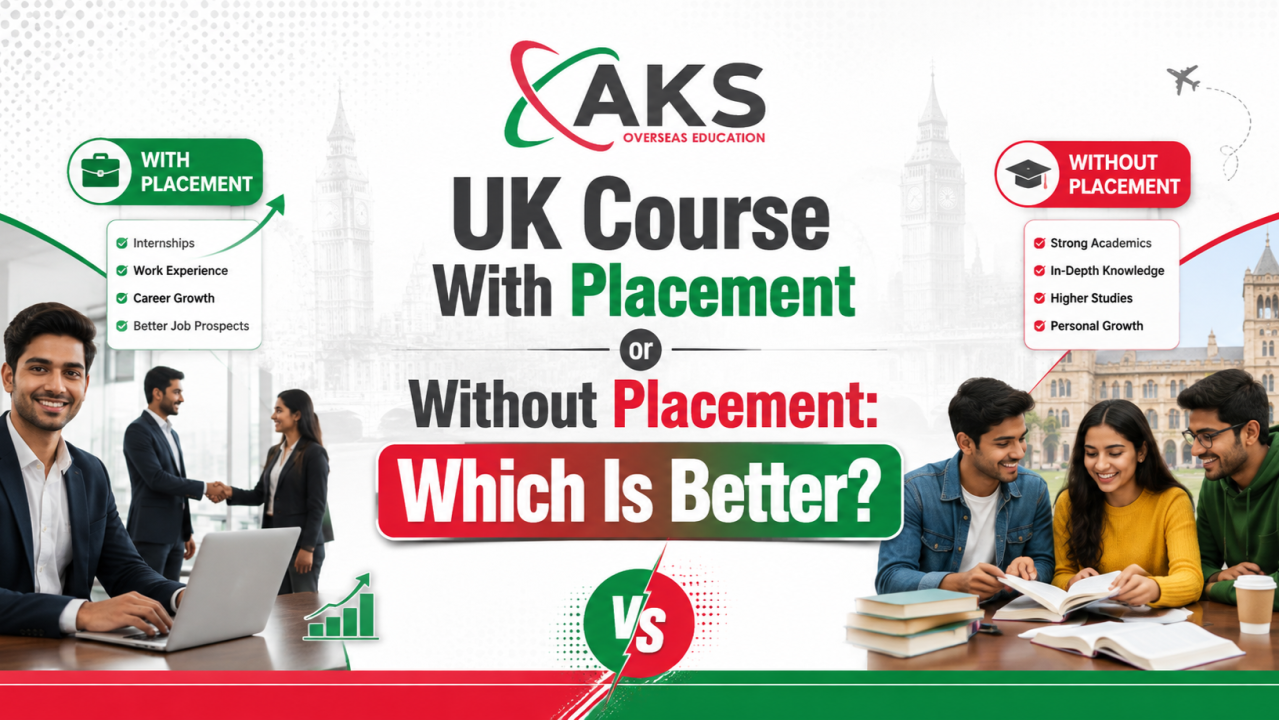
Choosing between a UK course with placement or without placement can feel harder than choosing the university. One may offer UK work experience. The other helps you finish faster and may cost less.
Here is the short answer. A UK course with placement may be better for fresh graduates, students changing their career, and anyone who wants a clear chance to gain UK work experience while studying. A UK course without placement may be better for students who already have good work experience, have a tight budget, or want to finish their degree as soon as possible.
One truth matters: a placement course does not always mean the university will hand you a job. You may need to search, apply, attend interviews, and win the role yourself.

What Is a UK Course With Placement?
A UK course with placement includes a period of work experience as part of the course. Universities may use names such as:
- Placement year
- Professional placement
- Industrial placement
- Year in industry
- Internship route
- Sandwich course
- Work-based project
The meaning can change from one university to another. Some courses offer several months with an outside company. Others may use a company project or work-based task as a backup.
Many master's courses last one year, while a placement route may last close to two years. A placement may add a year to a bachelor's degree. Check the exact course page.
The placement must be an approved and assessed part of the course. You may need to complete a report, project, or learning record.
What Is a UK Course Without Placement?
A UK course without placement mainly focuses on classes, exams, and a final project. It may still include career support, company visits, short projects, and job fairs, but no long placement period is built into the course.
Many full-time UK master's degrees without placement can be completed in one year, helping students move to the next step faster.
You can still build a good CV through allowed part-time work, short internships, company projects, student groups, and personal projects. The result depends on how well you use your time.
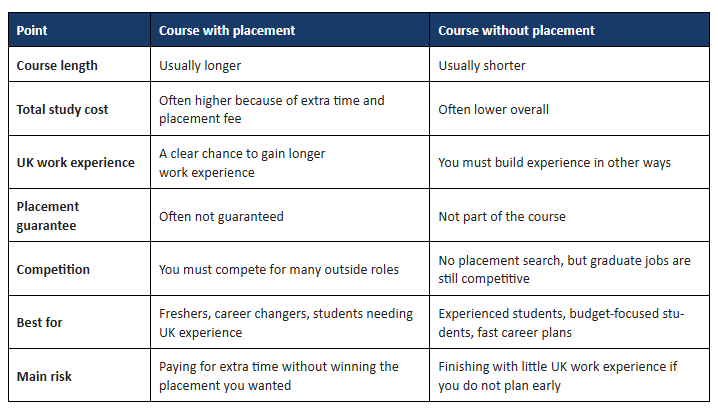
UK Course With Placement vs Without Placement: Quick Comparison

Benefits of Choosing a UK Course With Placement
1. You can gain UK work experience
This is the biggest reason students choose UK courses with placement. A placement can show that you can use your knowledge in a real workplace. It can also teach you how UK teams, meetings, and work plans operate.
2. Your CV can become stronger
A good placement may give you work results, software skills, team experience, and a manager who can give you a reference. These real examples can make your future interview answers stronger.
3. You can understand your career better
Working in the field can show whether you truly enjoy it. A data science student may prefer business analysis to coding. A marketing student may discover an interest in paid ads or research. This can guide your next career step.
4. You can build useful contacts
You may meet managers, team members, clients, and recruiters. These contacts do not promise a job, but they can help you learn what employers expect.
5. You get more time to grow in the UK
A longer course gives you more time to improve your English, understand the UK job market, and prepare for interviews. This helps only when you use the time well.
Risks and Extra Costs of a Placement Course
A placement is usually not automatic
Many universities provide CV help, mock interviews, job boards, and career events. However, the employer usually selects the student, and placement roles can be competitive.
Before paying a deposit, ask this exact question: "Is an outside company placement guaranteed, or does the university only offer support to apply?"
Ask what happens if you do not find one. You may move to the normal course, complete a company project, or face a change in your course length. Get the answer in writing.
You may spend more money
A longer stay can mean extra rent, food, travel, health charge, and daily costs. Universities may also charge a placement-period fee because you remain a registered student. The amount differs by course.
Do not assume that a placement salary will cover every cost. Roles may be paid or unpaid. Check the written offer before making your budget.
You must start applying early
Popular roles receive many applications. Start improving your CV and professional networking profile during the first weeks of the course. Apply to suitable employers of different sizes instead of waiting for the placement period to begin.
You may need to be flexible about the city
The right placement may be in another city, creating travel or moving costs. Applying only within a small area may reduce your chances.
Benefits of a UK Course Without Placement
1. You can finish faster
If your main goal is to complete a master's degree quickly, a one-year course can help you move to jobs, further study, or your career in India sooner.
2. Your total cost may be lower
A shorter course normally means fewer months of rent, food, and other living costs. This can reduce the pressure on your family or education loan.
Compare the full cost, including tuition, living costs, travel, visa-related costs, and an emergency amount.
3. It can suit students with work experience
If you already have good work experience, you may not need a long placement to prove that you can work. A focused course, strong UK projects, and early job applications may suit you better.
4. You can still build work-ready skills
Choose modules with live projects, join career events, build a portfolio, and use career support from the first month. Starting the job search only after the final exam may be too late.
Which Option Is Better for You?
Choose a UK course with placement if:
- You are a fresher or have very little work experience.
- You are moving into a new career field.
- You want a planned chance to gain longer UK work experience.
- You can manage the extra course time and living cost.
- You are ready to apply to many employers and face interviews.
- You can be flexible about the role, company size, and city.
Choose a UK course without placement if:
- You already have strong work experience.
- You want to finish your master's degree faster.
- Your budget cannot safely cover another year.
- You have a clear career plan and can build experience through projects or short roles.
- You are planning to return to India soon after the course.
- The placement route offers weak support or unclear terms.
Three Simple Student Examples
Example 1: A BCom fresher from Coimbatore
She has no full-time work experience. If her family can manage the cost and she is ready for a competitive search, a placement course may build her confidence and CV.
Example 2: A software developer from Chennai
He has three years of coding experience and wants to move into data work. A one-year course with strong projects may be enough if he builds a data portfolio and applies early.
Example 3: A student using a large education loan
His budget works only if he gets a well-paid placement. Since the role and salary may not be guaranteed, a shorter course with a safer money plan may be wiser.
Your experience, money plan, subject, and career goal must decide the route.
UK Student Visa Rules You Should Know
A placement under the Student visa must be an approved and assessed part of your course. UK sponsor guidance also says that time spent on a permitted placement can be in addition to the normal work hours allowed during study. For many full-time degree-level students at an eligible higher education provider, the usual term-time work limit is 20 hours a week. Your own visa conditions and university dates must always be checked. See the current UK Student sponsor guidance.
Do not confuse a course placement with the Graduate visa. The placement happens as part of your Student visa course. The Graduate visa starts only after you successfully complete an eligible course and meet the rules. Under the rules current in August 2026, non-doctoral applicants receive two years if they apply on or before 31 December 2026, and 18 months if they apply on or after 1 January 2027. Doctoral graduates continue to receive three years. Check the current Graduate visa rules.
Visa rules can change. Before you pay a deposit or make a course change, check the latest course offer, CAS details, university visa advice, and official UK rules.
Questions to Ask Before Choosing a Placement Course

Ask the university or your study abroad counsellor these questions:
- Is the placement guaranteed, competitive, or replaced by a project if I do not get one?
- How long is the placement period?
- Is the placement paid or unpaid?
- Who finds the role, the student or the university?
- What career support is included?
- How many students got an outside placement in the last group?
- Which companies and job roles took students from this course?
- What is the placement-year tuition fee?
- What happens to my course and visa if I do not secure a role?
- Can the placement be in another UK city?
- What are the application and approval deadlines?
- Is the placement clearly included in the course offer and CAS?
Do not choose a course only because "placement" appears in the title. Look for clear rules, useful support, a fair backup plan, and a course that matches your career.
How to Improve Your Job Chances on Either Route
Whether you choose a UK course with placement or without placement, start career work early.
- Make a simple UK-style CV.
- Update professional networking with your course, skills, and projects.
- Attend career fairs and employer talks.
- Practise interviews every week.
- Build proof of your work, such as reports, designs, code, or case studies.
- Speak with teachers, seniors, and career advisers.
- Apply for roles that match your skills.
- Learn from each rejection and improve the next application.
The course title can open a door, but your skills, effort, communication, and timing help you walk through it.
Final Answer: Placement or No Placement?
For a fresher with enough money and a strong desire to gain UK work experience, a UK master's with placement can be the better choice. It gives more time and a clear route to test classroom learning in a workplace.
For an experienced student, a student with a tight budget, or someone who wants a fast degree, a UK course without placement can be the better and safer choice. It saves time, may reduce the total cost, and can still lead to good career results when the student builds skills and applies early.
The best course is not the longest course or the course with the biggest promise. It is the course that fits your career goal, money plan, past experience, and readiness to act.
AKS Overseas Education helps students from Tamil Nadu compare UK universities, course options, placement terms, fees, scholarships, and visa steps. Our team can help you check what the university is truly offering before you make a decision.
Planning to study in the UK? Contact AKS Overseas Education for clear course guidance.
Phone: +91 93612 06919
Website: www.aksoverseaseducation.com
Frequently Asked Questions
1. Is a placement guaranteed in a UK master's course?
Usually, no. Universities may offer career support, but students often have to apply and pass the employer's selection. Check the exact promise and backup plan in writing.
2. Are UK placements paid?
Some placements are paid and some are unpaid. Pay depends on the employer, job, sector, location, and course rules. Never build your full money plan on an expected salary before you have a written offer.
3. Does a course with placement cost more?
It often costs more overall because the course and UK stay are longer. Even with a lower placement-year fee, you may still have rent, food, travel, and other costs.
4. Can an international student do a full-time placement in the UK?
Yes, when the placement is an approved and assessed part of the course and follows Student visa rules. The university must approve and monitor it. Always check your own visa conditions before starting.
5. Can I get a good UK job without choosing a placement course?
Yes. A placement can help, but it does not promise a graduate job. Students without placement can still build a strong profile through live projects, short internships, part-time work allowed by their visa, career events, and early job applications.
6. Is placement the same as the Graduate visa?
No. A placement is part of your course under the Student visa. The Graduate visa is a separate route that eligible students may apply for after successfully completing their course.
7. Can I move from a course without placement to one with placement later?
It may be possible in some universities, but it is not automatic. The course, CAS, visa period, academic progress, fees, and university deadline can affect the change. Ask before accepting the original offer.
8. Which course is better for a fresher from India?
A placement course may be useful for a fresher because it offers a planned chance to gain work experience. However, the student must have a safe budget and be ready to compete for roles. Course quality and placement support matter more than the word "placement" alone.