
UK Student Visa 2026: How Much Bank Balance Do Indian Students Need?

Hello there, friends! Greetings from AKS Overseas Education.
If you are reading this, I know something amazing about you. You have a big dream. A dream to fly across the ocean, land in the United Kingdom (UK), and study at a world-class university.
That is a fantastic dream! For over 15 years, I have helped thousands of students right here in Tamil Nadu turn this dream into reality. I’ve seen the happiness on their faces when they get that visa stamped.
But I also know that thinking about study abroad can be confusing. There are so many forms, rules, and questions. The biggest question I hear every day is: "How much money do I need to show for my UK Student Visa in 2026?"
Don’t worry. Sit back, relax, and maybe grab a cup of coffee. I am going to explain exactly how much bank balance Indian students need for the UK Student Visa. I promise to make it very simple—as easy to understand as your school exams!
Let’s dive in.
What Exactly is the "Bank Balance" Rule?
Before we talk about the numbers, let’s understand why the UK government asks for this.
Imagine you are inviting a friend from another city to stay with you for a year. You would want to be sure they have enough money for their bus ticket and food, right? You wouldn't want them to go hungry or get stuck without cash.
The UK government thinks the same way. When you apply for a UK Student Visa (often called a Tier 4 Visa), they want to see "proof of funds." This is a fancy way of saying they need to be 100% sure you can pay for your studies and live comfortably in the UK without needing their help.
They don’t want you to work part-time just to buy food; they want you to focus on your studies! So, you have to show that this money is waiting in a bank account, ready to be used.
The Simple Formula for Your UK Visa Funds
The total amount you need to show in your bank balance isn't a random number. It is made up of two distinct parts. It looks like this:
Total Funds Needed = (Total Tuition Fees for 1 Year) + (Living Expenses for 9 Months)
It’s that simple! Let's break these two parts down so you understand exactly how they affect you.
Part 1: Your Tuition Fees (The Cost of Your Course)
This part depends completely on which university you are going to and what you are studying. An Engineering degree at a famous university might cost more than an Arts degree at a smaller one.
How it works: The UK government expects you to have enough money to pay for the first year of your course. If your course is shorter than a year, you must show the full amount.
Let’s use an example. Imagine your total fees for the first year is £20,000 (roughly 20 Lakh Rupees, depending on the exchange rate).
- If you have already paid £5,000 to the university as a deposit, you only need to show the remaining £15,000 in your bank balance.
- The university will give you a dynamic letter called a CAS (Confirmation of Acceptance for Studies). This document will clearly state exactly how much you have paid and exactly how much you still owe. This is the official number you must use.
Part 2: Your Living Expenses (The Cost of Daily Life)
This is where many students get confused, but I’m going to make it crystal clear for you. The UK government sets a fixed amount they think a student needs to live for one month. This money covers things like renting a room, buying food, taking the bus, and paying for electricity.
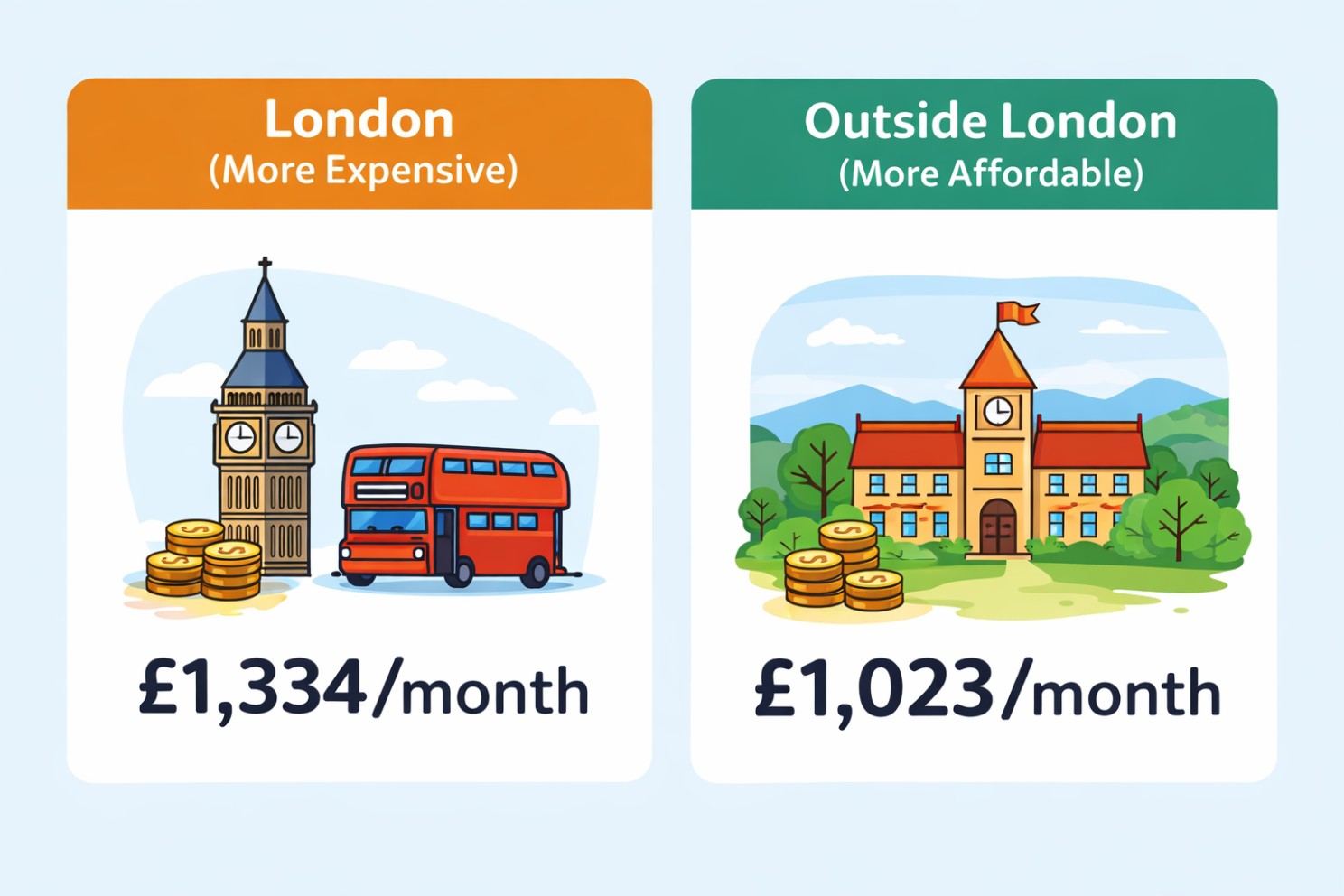
Where you live in the UK makes a HUGE difference. The UK is divided into two areas for this rule: London and Outside London.
As we look toward 2026, we expect these standard amounts to rise slightly to account for inflation (things getting more expensive over time). Here are the estimated amounts you should keep in mind:
Scenario A: Studying in London
London is an amazing city—the capital! But it is also the most expensive place to live in the UK.
If your university is inside the boundaries of London (which AKS Overseas Education can check for you), the UK government requires you to show higher funds.
- Estimated Monthly Living Cost (London): £1,334 per month.
- Total for 9 Months (The Rule): £1,334 x 9 months = £12,006.
So, if you are going to London, you must show roughly £12,006 just for living costs. (That's about 12.5 Lakh Rupees, roughly).
Scenario B: Studying Outside London (Rest of the UK)
Many excellent UK universities are located in cities like Manchester, Birmingham, Edinburgh, or smaller, lovely towns. These places are generally cheaper than London.
If your university is anywhere except London, the required amount is lower.
- Estimated Monthly Living Cost (Outside London): £1,023 per month.
- Total for 9 Months (The Rule): £1,023 x 9 months = £9,207.
Going to a city outside London? You need to show £9,207 for living costs. (That's about 9.6 Lakh Rupees, roughly).
Let’s Do the Math: A Real Example
I know what you are thinking: "Okay, I understand the parts, but what does the total look like in Rupees?"
Since the exchange rate between the UK Pound (£) and the Indian Rupee (₹) changes every single day, the exact Rupee amount will change. For our example in 2026, let's make a guess that £1 = ₹105. (This is just an example; the real rate might be different).
Let’s imagine our friend, Arun, from Chennai.
Arun has been accepted to study Computer Science at a great university in Manchester (which is Outside London).
- Arun's Tuition Fees (1st Year): £18,000. Arun already paid a deposit of £4,000. Remaining Fees to Show: £14,000.
- Arun's Living Expenses: Since Manchester is Outside London, the calculation is £1,023 x 9. Total Living Expenses to Show: £9,207.
Arun's Total Required Bank Balance (£): £14,000 (Fees) + £9,207 (Living) = £23,207.
Arun's Total Required Bank Balance (₹, estimated): £23,207 x ₹105 = ₹2,436,735.
So, Arun needs to show that he has roughly 24.5 Lakh Rupees available in his bank account for his visa application.
Wait! Does Arun need to have this money exactly when he clicks 'submit' on his application? This brings us to the most important rule of all...
The "28-Day Magic Rule": Don't Miss This!
Listen very carefully, my friends. This is the part where many students make a mistake, and their visa gets rejected. It breaks my heart when this happens.
The UK government does not just want to see that the money is in your account today. They want to know it has been there for a while. This proves the money is yours and not just borrowed for a day to show off.
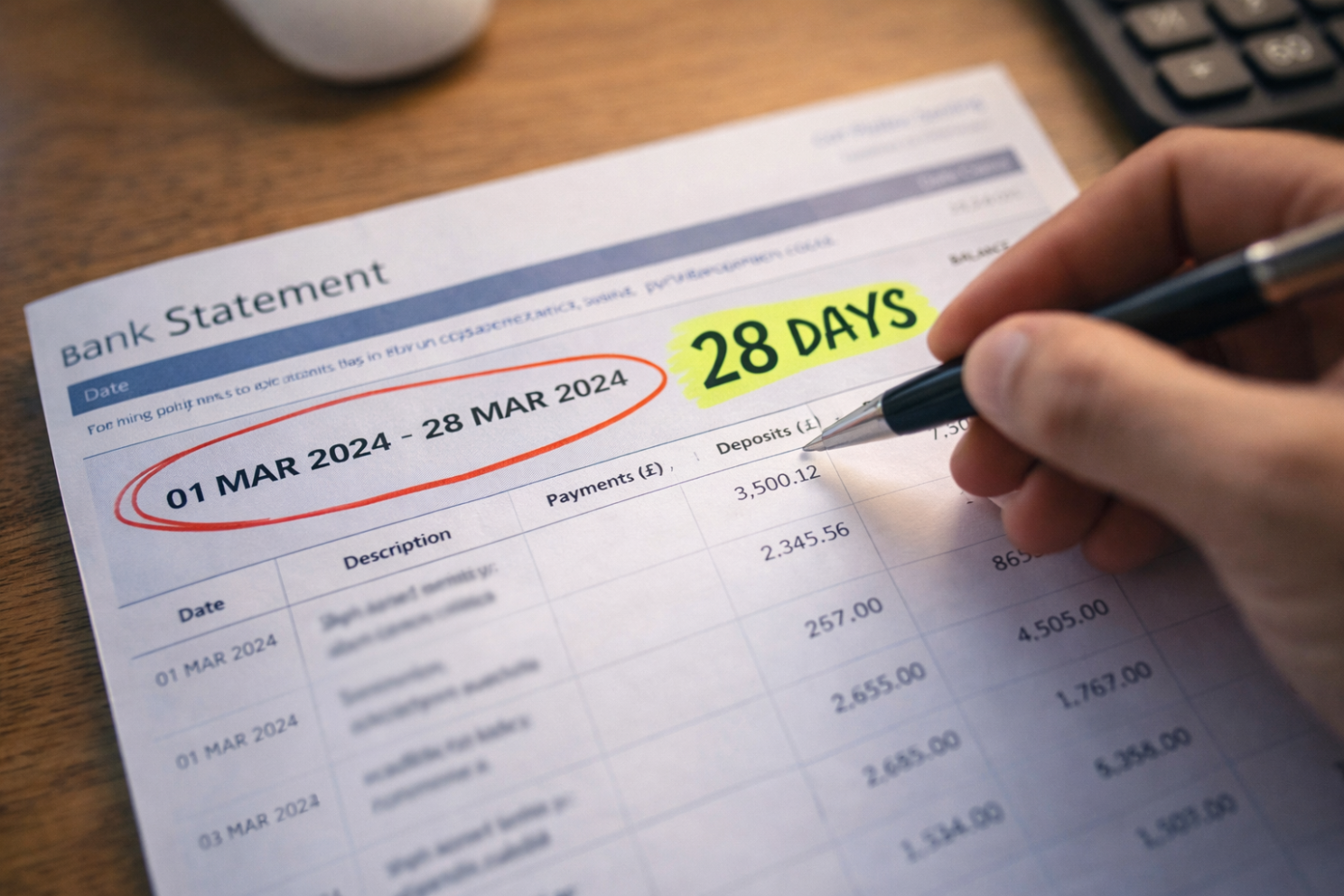
The rule is this: The total required amount (Fees + Living Expenses) must be in your bank account for a continuous period of 28 days.
What does "continuous" mean? It means the balance must never, ever drop below the total required amount—not even for one second—during that 28-day period.
- If you need to show £23,000 and your balance drops to £22,999 on day 15, the 28-day clock resets! You have to start all over again from day 1.
Furthermore, when you get your bank statement (the official summary of your account) to send with your visa application, that statement cannot be older than 31 days.
This seems like a small detail, but at AKS Overseas Education, we have seen that it is the single most common reason for a visa refusal. Planning this 28-day period perfectly is crucial.
Whose Bank Account Can I Use?
This is another common question from students in Tamil Nadu. The UK visa rules are very strict about whose money you can use.
✅ YES: This is allowed:
- Your Own Account: An account in your name (the student’s name).
- Your Parent’s Account: A savings or current account in the name of your mother or your father (or a joint account they share).
- Your Legal Guardian's Account: If you have an official legal guardian (not just an uncle or aunt you are close to).
Important Note: If you are using your parents' account, you MUST include your original birth certificate to prove you are their child. You also need a simple letter from them saying, "Yes, this is our money, and we give our child permission to use it for their studies."
❌ NO: This is NOT allowed:
- The account of an uncle, aunt, or grandparent.
- The account of a cousin or a family friend.
- A business/company bank account (unless the money is clearly given to your parent as a director and moved to their personal account).
You must show that the money is available exclusively for your education.
What Types of Accounts are Accepted?
The money must be in a "liquid" account. This means you can take it out immediately if you need to. The UK government wants to know that if you have to pay tuition fees tomorrow, the cash is ready.
Accepted Accounts:
- Savings Account: The most common and easiest option.
- Current Account: Also acceptable.
- Fixed Deposit (FD): This is accepted only if the bank gives you a letter stating that the deposit can be broken immediately and withdrawn in cash (a "non-withdrawable" FD is not okay).
Accounts NOT Accepted:
- Shares or mutual funds.
- Property or land valuations.
- Retirement funds (like PF or EPF) unless they are already withdrawn and placed in a savings account.
- Gold.
The Best Solution: An Education Loan
Is gathering 25 Lakh Rupees and letting it sit in a bank account for 28 days too difficult? For many families in Tamil Nadu, this is a big challenge.
Don’t give up on your dream yet!
A UK Education Loan from a recognized Indian bank (like SBI, Axis Bank, HDFC, or IDFC) is a fantastic and popular solution. The UK government accepts an official "Loan Sanction Letter" as proof of funds.
The Loan Advantage:
- You don't need to put your own family savings at risk.
- You don't need to wait for 28 days! Once the loan is approved and you have the sanction letter, you can apply for your visa immediately. The letter itself proves the bank is promising you the money.
At AKS Overseas Education, we help you navigate the entire education loan process, making it simple to get the letter you need for your visa.
Common Mistakes to Avoid (Trust an Expert!)
In my 15 years of experience, I’ve seen that small mistakes can lead to big disappointments. Here are the top three mistakes that Tamil Nadu students make, which you must avoid:
- Using Borrowed Money Without Planning: Borrowing money from a relative for just 30 days and letting it sit in an account looks suspicious. The UK visa officer might question if it is genuinely yours to spend. It's always better to use an education loan.
- Forgetting to Cover Currency Fluctuations: The Rupee price of a UK Pound changes daily. If you plan to show exactly ₹25 Lakhs, and the value of the Rupee falls tomorrow, your total £ amount might become too low. At AKS Overseas, we always advise students to show 10-15% extra in their bank account to be perfectly safe from these changes.
- Using the Wrong Bank: The UK government has a specific list of banks in India whose statements they do not trust. You must use a reputable, standardized bank. If you are unsure if your bank is accepted, ask us at AKS Overseas.
How AKS Overseas Education Makes it Easy for You
Does all this talk of pounds, rupees, 28-day rules, and bank statements sound overwhelming?
That is exactly why we are here!
As an expert who has spent over 15 years in this field, specializing in helping students from Tamil Nadu, I know this process inside and out. I understand the challenges and the stress. Our mission at AKS Overseas Education is to hold your hand through this entire journey.
When you work with us, you aren't just a client; you are a student with a big dream, and we take that very seriously. We offer personalized counseling in a friendly, interactive way. We won't give you confusing AI-generated advice. We are real people who care about your future.
Here is what we do for you:
- Financial Check: We look at your family's financial situation and create a detailed, custom plan. We will tell you exactly how much money you need to show, based on your chosen university.
- Bank Statement Verification: Before you submit your visa, we meticulously review your bank statements. We check the dates, the balance, and everything else to make 100% sure it meets the UK government’s standard.
- Loan Assistance: If you need an education loan, we have special partnerships with banks to help you get your sanction letter quickly and easily.
- The CAS Check: We carefully verify your CAS letter to make sure it matches your personal documents perfectly.
In short, we take the stress away so you can focus on the exciting part: packing your bags for the UK!
Final Thoughts: Your Dream is Reachable
So, there you have it. The secret to the UK Student Visa bank balance isn’t a scary secret at all. It’s just simple planning, careful calculation, and following the rules perfectly.
Yes, the UK Student Visa in 2026 will have financial requirements. Yes, you need to show significant funds. But by breaking it down into a formula, understanding the 28-day rule, and getting the right guidance, it is entirely possible.
Remember Arun from our example? He is studying in Manchester now, well on his way to a brilliant career. You can be that student, too.
Don’t let confusion stop you. Your big dream of studying in the UK is waiting. All you need is the right guidance to open that door.
If you are ready to make that dream happen, why not start with a free, friendly chat? Come visit us at AKS Overseas Education. We are excited to hear about your goals and to show you how easy it can be to start your UK adventure.
Call us today! Let’s make 2026 the year you fly!