
Your First Month in the UK: A Practical Arrival Checklist for Indian Students

You have reached your university city. Your suitcase is open, messages from home are arriving and the welcome email contains more links than you expected. What should you do first?
For Indian students beginning a UK degree, the first month is easier to manage when practical tasks are grouped into a few clear priorities: university access, everyday essentials, local support and a workable weekly routine. You do not need to solve every unfamiliar detail on the first evening.
A useful starting point: follow your university’s official arrival and enrolment instructions, make sure you can access your student accounts, plan how to pay for immediate essentials and find the support services relevant to your location. Then turn those essentials into a routine that leaves room for study, rest and meeting people.
This guide from AKS Overseas Education focuses on settling in. University procedures vary, and healthcare arrangements differ across the UK nations. Use the linked official guidance and your institution’s current instructions for decisions that depend on your circumstances.
Before the first busy morning, make one arrival folder
Create a small, organised folder containing the information you are likely to need repeatedly. Keep secure digital copies available and carry only the documents needed for the task you are completing.
Useful items to organise include your university correspondence, enrolment instructions, accommodation contact, local address and the official contact details for student services. Keep your travel and identity records protected. Avoid sharing copies in informal groups simply because another student says the group is helping everyone register.
Add a simple task list with three columns: what needs doing, which official team can answer questions and what information you need before starting. This turns a large welcome pack into a manageable sequence.
For example, a banking enquiry might depend on confirming your address or obtaining a university letter. An appointment may need to fit around an induction session. Recording these dependencies helps you avoid repeating a journey because one item was missing.
Leave space for questions. A folder should help you find information, not become another complicated project to maintain.
Your first university priority: access and enrolment
Read the arrival instructions sent directly by your institution. Complete the required steps using the university’s official portal and contact the relevant team if the process is unclear. Do not assume that accepting an offer means every arrival task has already been completed.
Check that you can use your student email, timetable, learning platform and library account. If access fails, record the exact problem and use the official IT support route. A screenshot with sensitive information removed can make a support request easier to understand.
Put scheduled induction sessions in your calendar. These sessions may explain course expectations, support routes and everyday campus arrangements that are difficult to reconstruct from other students’ summaries.
Find the location of your first teaching room before the day you need it. A campus map that looks straightforward on a phone can feel less obvious when you are carrying a bag in unfamiliar weather. A short practice walk is a simple way to remove one avoidable source of stress.

Illustrative campus welcome scene. Your university’s own arrival information should guide the steps for your course and location.
Plan banking as a process, not a same-day guarantee
It is sensible to investigate account options early, but do not organise your entire first week around the assumption that one application will be completed immediately.
UKCISA explains that banks can differ in the accounts available to international students and the documents they request. Check the chosen provider’s requirements and ask your university whether it can supply relevant supporting documentation. UKCISA: opening a bank account
Before choosing an account, write down the practical questions you need answered. Can you use the service in the way you expect? What charges apply to the transactions you anticipate? What support is available if your card or account access stops working? Read the provider’s current information rather than relying on an old social-media comparison.
Keep a realistic plan for immediate essentials while the application is being processed. Discuss your needs with your existing financial providers before travelling where possible, and understand their current overseas charges and access arrangements.
Do not give passwords, one-time codes or control of an account to a person offering to speed up the process. If an unexpected message requests payment or account information, contact the institution through a route you have independently verified.
Find the healthcare route for where you live
Make healthcare orientation an early task instead of waiting until you feel unwell. Ask your university where to find the relevant local NHS information and how to access student health support.
For students in England, NHS guidance advises registering with a local GP practice when spending most of the year at a university address. It also explains that students may need to arrange dental care separately. Read the full guidance for your circumstances. NHS: getting medical care as a student
Scotland, Wales and Northern Ireland have their own NHS information and arrangements. Use the guidance for the nation where you are studying rather than assuming that every procedure described on an England-focused page applies everywhere.
If you have an ongoing health condition or regular medicine, ask an appropriate healthcare professional how to plan continuity of care. Keep relevant records securely available for the clinician who needs them. A student adviser can help you find the right service, but should not replace clinical advice.
Record the official local routes for urgent and non-urgent help. For an immediate emergency in the UK, call 999. For other situations, check the relevant NHS guidance so you understand which service to contact and when.
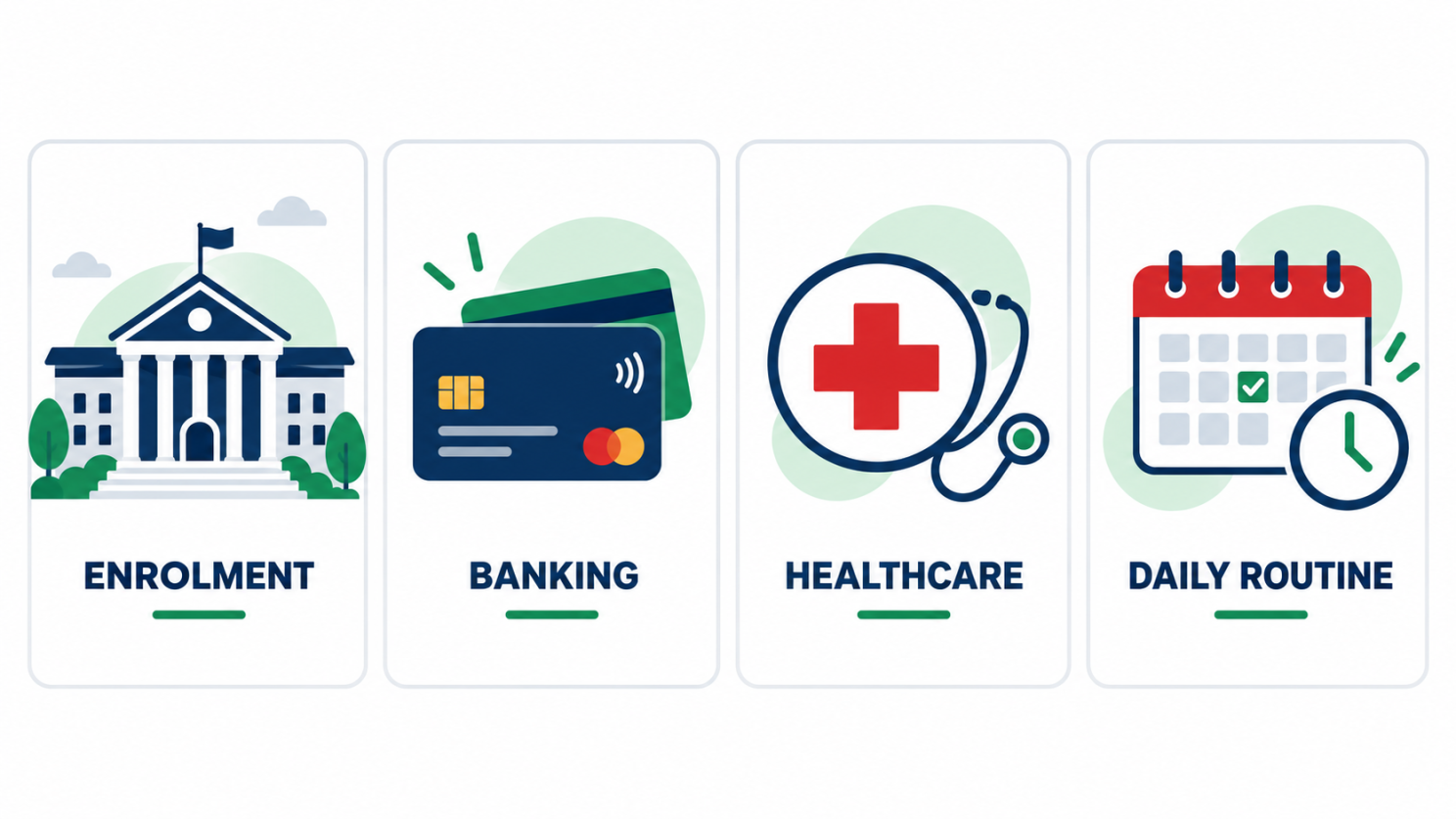
Four practical foundations for settling in: enrolment, banking, healthcare and a manageable routine.
Make your first budget about real spending
Before arrival, a budget often contains broad estimates. Once you are in your university city, use actual prices and your own routine to refine it.
Separate one-time setup purchases from recurring spending. Bedding or a kitchen item may be an initial cost; groceries, transport and phone service follow a different pattern. If everything is placed in one total, the first week can give a misleading picture of what a typical week will cost.
Keep a short spending record for the first few weeks. You do not need a complicated spreadsheet. Note the category, amount and whether the expense is likely to repeat. Review it at a set time so that small purchases do not disappear from memory.
Avoid copying another student’s weekly total without checking what it includes. Their housing arrangement, travel distance or meal routine may be different from yours. A useful budget reflects your circumstances and leaves room for costs that are not yet certain.
If the figures do not work, speak to the university’s student money or support team early. Do not assume that future earnings, an unconfirmed discount or a hoped-for payment will solve an immediate gap.
Learn the journey you will actually make
Transport research becomes more useful when it starts with a real route: home to campus, campus to the grocery shop and the return journey at the time you expect to travel.
Check the operator’s official information for the service, payment method and any relevant ticket conditions. A pass that looks inexpensive may not cover the route or times you need. Confirm student-discount eligibility directly rather than assuming your university status automatically gives access to every offer.
Try the journey before an important class or appointment. Record a practical alternative in case the usual route is disrupted. Keep enough time in the first week to navigate without rushing.
For walking routes, notice crossings, lighting and the entrances that remain available at the times you expect to use them. Follow campus safety advice and ask the university team about unfamiliar local arrangements.
These small observations turn an unfamiliar city into a set of known journeys. That confidence can be more helpful than memorising a long list of attractions in your first few days.
Build familiarity without filling every evening
It is possible to feel excited about studying abroad and unsettled at the same time. A difficult day does not, by itself, tell you whether you chose the right course or country.
UKCISA describes culture shock as a common experience for international students. Its guidance highlights the value of institutional support, orientation and opportunities to connect with others. UKCISA: facing culture shock
Choose a few manageable opportunities to meet people: a course activity, a society related to an existing interest or a campus event that fits your schedule. You do not have to join every group during welcome week.
Keep regular contact with people at home while allowing time to establish local relationships. Agree a communication routine that works across the time difference and your teaching schedule. Families can help by listening to the ordinary details of the week as well as asking about progress.
If settling in feels persistently difficult, contact student support or an appropriate health professional. Asking for help early gives the university a chance to understand what is happening and discuss the support available.
A settled first month is built from repeatable basics: know where to go, who to ask and what tomorrow requires.
Editorial takeaway from this AKS Overseas Education arrival guide.

Illustrative planning desk. A short weekly review can keep practical tasks from competing with every study session.
An illustrative first-month plan
Consider a fictional Indian student arriving for a postgraduate course. In the first few days, she tries to complete every administrative task and attend every welcome event. She ends the week tired, with several half-finished applications and uncertainty about her first class location.
She reorganises her list around dependencies. University access and the timetable come first. She checks which documents her chosen bank needs, asks the correct university team for clarification and sets aside a separate time for local healthcare registration. She tests the campus journey and chooses one society event that genuinely interests her.
At the end of the second week, she reviews actual grocery and transport spending. By the fourth week, her list is shorter because repeated activities have become routines.
This is a hypothetical planning example, not a reported AKS student outcome. The lesson is about sequence: a realistic schedule can be more useful than a long checklist treated as one urgent task.
Questions students and parents often ask
What should I prioritise during the first week?
Follow the university’s required arrival steps, confirm access to student systems and organise immediate living essentials. Identify banking and healthcare requirements early, then schedule the remaining tasks around teaching and induction.
Should I follow advice in student WhatsApp groups?
Groups can offer useful personal experiences, but verify procedures, payments and deadlines with the university or responsible organisation. Another student’s situation may differ from yours, and an old screenshot may no longer reflect current instructions.
What if a task takes longer than expected?
Contact the responsible team with a clear description of the issue and any requested information. Record the response and your next action. If the delay affects another deadline, tell that team as well rather than assuming the systems will communicate automatically.
How can parents support the first month?
Agree a reasonable check-in routine, help the student organise questions and encourage use of official support services. Avoid treating every unfamiliar situation as a crisis; equally, take sustained difficulties seriously and help the student reach appropriate support.
Prepare for a routine, not just an arrival
A successful start is not measured by how quickly every task disappears. It is measured by whether you can attend your course, manage everyday needs and find help when something is unclear.
For students preparing to study in the UK, AKS Overseas Education can be a starting point for discussing preparation questions and identifying what to confirm with the institution. Use current university, UKCISA and NHS guidance for the details that apply to you. A thoughtful first-month plan leaves more attention for the reason you travelled: learning and building your next stage of life.