
Your First UK University Assignment: Referencing, Academic Integrity and Study Habits for Indian Students

Getting an offer is one milestone. Learning how your course expects you to work is another. The first assignment can feel unfamiliar even when you understand the subject. You may be asked to compare arguments, evaluate evidence or explain a position rather than reproduce everything you have read.
For Indian students beginning a UK degree, a useful preparation plan includes reading the assessment brief, learning the required referencing style and finding the university's academic support services. This guide offers a practical starting routine. Your own module instructions and university policies always take priority over a general checklist.
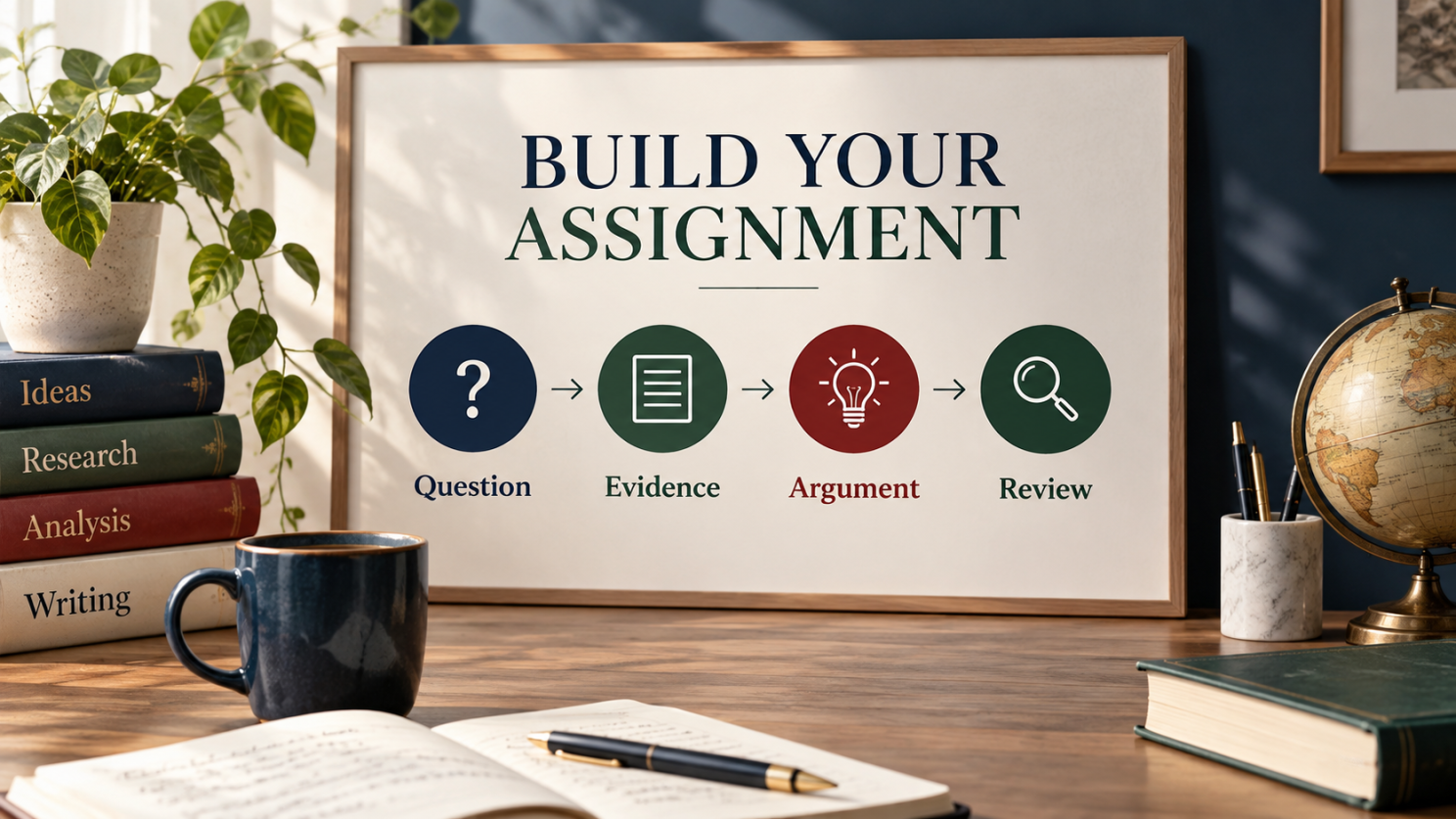
Quick answer: Start with the assignment question and marking criteria. Plan an answer, gather reliable sources, record references while reading, distinguish your ideas from other people's work, and check the rules for collaboration and AI tools before using them. Leave time to revise and verify the submission.

Read the brief before you start collecting material
Open the complete assessment brief and identify the task, format, word limit, deadline and submission route. Note any requirements about sources, structure, appendices or supporting files. An attractive essay on the wrong question still misses the assignment.
Pay attention to the instruction words. Compare, evaluate and describe ask for different kinds of work. If the meaning is unclear in your subject, ask the module tutor for clarification or use the university's study-skills resources. Do this early enough to change your plan.
Create a short task summary in your own words. Then check it against the original brief. This simple step helps reveal whether you have turned a specific question into a much broader topic that will be difficult to answer within the available space.
Use the marking criteria as a planning aid
Many assignments provide criteria or a rubric explaining what the assessor will consider. Read it before drafting. Look for the relationship between the task and expectations such as analysis, evidence, organisation or technical accuracy.
Turn the criteria into review questions. If the assessment values evaluation, ask where your draft weighs the strengths and limitations of an argument. If source use matters, ask which claims are supported and whether the references are appropriate.
Avoid treating the rubric as a script for artificial phrases. The goal is to produce the work it describes, not to insert words such as critically without doing the analysis. A clear explanation usually serves the reader better than unnecessarily complicated language.
Build an answer plan, not a list of everything you know
Write a provisional answer to the central question in a few sentences. It can change as you read. This gives your research a direction and helps you decide whether a source contributes to the assignment or merely interests you.
Arrange the main points in a logical sequence. Each section should have a purpose in the overall answer. If two sections repeat the same idea, combine or distinguish them before spending time on polished paragraphs.
Keep a separate place for useful material that does not belong in the current draft. Removing an irrelevant point is not wasting your reading. It is making a decision about what the reader needs to understand your argument.
Take notes that preserve the source
Record the author, title, publication details and relevant location while you read. Include the link or other identifier where appropriate. Waiting until the night before submission to rebuild this information can turn a straightforward reference task into a frustrating search.
Make direct quotations visibly different from your own notes. Use quotation marks and record the page or other location required by the referencing system. Do not copy a paragraph into a notes file and assume you will remember later that it was someone else's wording.
Beside a source summary, add your own reaction: why it matters, what it supports, where it has limitations and how it relates to another reading. This helps you move from collecting material to using evidence in an answer.
Understand what attribution includes
Academic integrity concerns more than copying sentences. The University of Oxford's guidance explains that other people's ideas and material, including data, code and images, need appropriate acknowledgement. It also warns that changing a few words or following another text's structure too closely can still be problematic.
Use that principle alongside your institution's own guidance. Ask how to acknowledge the kinds of material your course uses, especially if you work with software, visual material, datasets or group outputs. Referencing conventions can differ between disciplines.
Do not assume that freely available material is free of attribution requirements. Being able to open a webpage without payment does not make its ideas your own. Record the source and follow the required method for using it in assessed work.
Practise paraphrasing as understanding
A useful paraphrase communicates the relevant idea in your own expression while preserving its meaning and acknowledging the source. It is not a word-replacement exercise. Read the passage, identify the point and explain it without looking at the original wording.
Then compare your version with the source. Check that you have not changed the claim, removed an important limitation or kept a distinctive sequence too closely. Add the reference required by your course even when the words are your own.
If exact wording is essential, a short, correctly presented quotation may be more appropriate. Use quotations purposefully and explain their relevance. A string of quotations should not be asked to do the work of your own analysis.
Learn one required referencing style properly
Your course may specify a particular referencing system or a departmental version of it. Use the university's official guide rather than mixing examples from unrelated websites. Check how that guide handles the source types in your assignment.
A reference manager can help organise records, but its output still needs checking. Imported records may have missing authors, incorrect dates or incomplete titles. The tool can format what it has been given; it cannot guarantee that the underlying information is correct.
Check the relationship between citations in the text and the final reference list. Make sure the reader can identify the source of a claim and locate the referenced work. Follow the course's distinction, if any, between a reference list and a broader bibliography.
Ask about AI and collaboration before using them
Do not assume that every UK university, module or assignment has the same rules for generative AI. Some uses may be permitted, some may require acknowledgement and some may be prohibited. Read the current instructions for the specific assessment and ask when uncertain.
The same applies to collaboration. Discussing a topic with classmates is not automatically permission to share a draft, divide an individual assignment or submit jointly produced text. Clarify where the boundary sits for your task.
Keep a record of permitted assistance when the course asks for it. Never invent references, data or an account of how work was produced. If a tool suggests a source, locate and read the actual source before relying on it.
Illustrative case: moving from a topic to an argument
Imagine a fictional student from Chennai starting a UK master's module. Their first plan for an assignment contains a long history of the subject but only a short answer to the question. Before drafting further, they compare the plan with the marking criteria.
They revise the structure around three relevant arguments, record sources beside each one and identify where evidence disagrees. They also ask the tutor how the module expects a particular dataset to be cited. The resulting process is more focused and easier to review.
This scenario is illustrative, not an AKS student testimonial or a promise of a grade. Its lesson is that seeking clarification and revising a plan are normal parts of independent academic work. Asking a good question early can be more useful than writing extra pages late.
A useful study principle: Keep the question, the evidence and your own reasoning connected in every section.
Build a schedule with a genuine revision stage
Work backwards from the deadline, leaving separate time for understanding the brief, reading, planning, drafting and checking. The proportions will differ by assignment. The important point is not to use the entire available period for the first draft.
Break the work into concrete sessions. Find and assess two relevant sources is easier to act on than do research. Review whether section two answers its question is clearer than improve essay. Small, defined tasks help you see progress and unfinished work.
Plan around the rest of your timetable and personal responsibilities. If circumstances affect your ability to submit, use the university's official support and extension procedures promptly. Do not rely on an informal assumption that a late file will be accepted.
Review the draft in more than one pass
First check the answer and structure. Does the introduction establish the task? Does each section contribute? Does the conclusion follow from the discussion? Fixing these questions before polishing sentences prevents wasted effort.
Next review evidence and attribution. Identify unsupported claims, incomplete citations and quotations that need clearer presentation. Check numerical statements against the source and make sure a limitation has not disappeared during editing.
Finally check readability and the required format. Read difficult passages aloud, simplify sentences where possible and verify file requirements. Follow the university's rules for any proofreading assistance rather than allowing another person to rewrite assessed work without permission.
Submit carefully and retain the confirmation
Use the official submission route and allow time for technical problems. Confirm that the uploaded file is the correct version and that required attachments are included. If the system provides a receipt or confirmation, keep it.
Do not interpret a similarity score as a complete judgement of academic integrity. The context of source use matters. Follow university guidance and ask the appropriate staff about concerns instead of trying to manipulate a number.
After feedback arrives, identify one or two changes for the next assignment. A comment about structure, evidence or citation is more useful when translated into a specific habit. Keep a short learning log so the same issue does not recur unnoticed.
Questions students often ask
Is simple English acceptable in academic writing?
Clear, precise language is valuable. Use the technical vocabulary your subject requires, but do not make sentences complicated merely to sound academic. Ask your university's writing support team for discipline-specific guidance.
Can a friend check my work?
Check the assessment's proofreading and collaboration rules first. The permitted level of help varies, and you remain responsible for the work you submit.
Who should I ask about an unclear instruction?
Start with the module's official contact or tutor. Library and academic-skills teams can also help with research and referencing, but the module team should clarify assessment-specific requirements.
Prepare for the learning, as well as the journey
Contact AKS Overseas Education to discuss study plans and the transition to university life. Once enrolled, use your university's own academic guidance and support services for assessed work. Preparing good habits early can make the first assignment feel more manageable.
Reference: University of Oxford: plagiarism and academic integrity guidance. Oxford's specific rules are not universal UK rules; follow the current policy of your own institution and course.